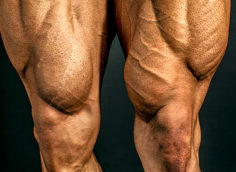
If I'm good at anything, it's the ability to take relatively well-known parameters and arrange them in a more effective manner. I'm ecstatic to inform you that I've been experimenting with a new method that induces a metamorphosis of size and strength. As the transcendent Bob Dylan once sang, "Times, they are a changin'." As such, be prepared for what follows!
One method that's always resurfacing in various forms in the field of hypertrophy training is the "burnout method." Excluding the awful name, a few trainees have found it somewhat useful in packing on a little muscle. It basically consists of performing an exercise with pseudo-maximal strength parameters, followed by a sub-maximal set taken to failure. It's reared its head in many forms, but one of the better known methods is this:
- Exercise: Squats (for example)
- Sets: 5
- Reps: 10, 8, 6, 4, 2
- Load: 10 Reps Max, 8RM, 6RM, 4RM, 2RM
Followed by:
- Exercise: Squats
- Sets: 1
- Reps: 18-20 (taken to failure)
- Load: 18-20RM
To summarize, the first five sets consist of increasing loads and decreasing reps in an effort to recruit the high-threshold fast-fatigable (FF) motor units. Once maximal strength has been "primed," one last set with a sub-maximal (~60% of 1RM) is taken to failure.
Not a bad idea, but it definitely has its shortcomings:
Shortcoming 1 – Failure Training
Bad, bad and more bad. Sending your kids to play with Michael Jackson bad. Training to failure is so outdated that I can't even bear to discuss it. Failure training induces excessive CNS fatigue. Successful training (of any sort) revolves around fatigue management. Therefore, any method that induces excessive fatigue should be avoided.
Bottom Line: The burnout method revolves around taking the last set to absolute failure and this should be avoided in order to keep the nervous system as fresh as possible.
Shortcoming 2 – Excessive Parameters
If you try to accomplish everything in one session, you're going to be in trouble, and overtraining will be right around the corner. If you focus on increasing one or two strength qualities during a single session, you'll be much better off.
Bottom Line: Excessive sets + Excessive rep ranges + Muscular failure = Shitty results.
Shortcoming 3 – Inferior Maximal Strength Gains
I don't care if you have no desire to ever step foot inside a powerlifting or Olympic lifting circle, you must be cognizant of maximal strength training if you want to become massive and massively strong.
Bottom Line: The burnout method leads to sub par strength gains which, in turn, wreak havoc on your hypertrophy efforts since the recruitment of the massive FF motor units are only emphasized in the middle portion of the workout.
Shortcomings 1 and 2 are relatively easy to resolve. Regarding failure training, the only modification that needs to be made is to stop one rep short of failure. Simple enough.
Shortcoming 2 (excessive parameters) can also be fixed. You could merely replace the inverse set/rep relationship with more constant parameters such as 3 x 3 or 5 x 5. But the biggest shortcoming of all (inferior maximal strength gains) hasn't been addressed – until now.
One of the most interesting observations I've made within the realms of iron apparatuses is that the nervous system best "remembers" the last set. It's akin to listening to a three-hour seminar: you usually only remember the end points. The same appears to be true with weight training.
Therefore, the traditional burnout method leaves your nervous system remembering a light load that primarily taxed the fast fatigue-resistant (FFR) motor units. This is bad news if it's done week in and week out because you'll lose your maximal strength levels in no time.
But wait, you don't care about maximal strength, you only care about muscle mass increases, right? Please refer back to my "bottom line" statement in the aforementioned point 3 before I track you down and choke you out!
I've found a better way. If you incorporate the following method into your next hypertrophy phase, you'll be bigger and stronger than ever. This method is based on three important principles:
- Avoiding absolute muscular failure.
- Maintaining relatively constant parameters that don't confuse the hell out of your nervous system.
- Achieving greater maximal strength increases.
Here's how it works. To begin, you'll perform the first compound exercise for 3-4 sets until you reach a 3RM for that lift. Remember, a 3RM represents a load you could lift for three perfect reps without losing form. If you must compromise form to reach the third rep, decrease the load 2.5% and try again.
Second, you'll pick a different exercise for the same muscle group and perform 12-14 reps while stopping one rep short of muscular failure.
Lastly, you'll perform one set of 2-3 reps with the same compound exercise that you start with. Oftentimes, you won't be able to perform all three reps with the same load you started with, but you should be able to perform at least two reps. This will effectively re-recruit the FF motor units so you won't leave the CNS remembering a light load.
Keep in mind, this isn't a "pure" maximal strength program; this is a hypertrophy-based program that also causes maximal strength gains.
I titled this program "Hybrid Hypertrophy" since it combines a few different methods into the same session. Up to this point, most of my programs revolved around training a single strength quality within each session. Since this program combines a few methods into each workout, you'll be able to perform it for up to four weeks before switching programs. (Some of my clients have performed this program for as long as six weeks without losing the effect, but stick to four weeks as a starting point.)
Note: Please do everything in your power to adhere to the following exercises. I tried to choose exercises that are virtually ubiquitous to every gym, whether it be commercial or home. Each day consists of specific exercises that I've found most useful.
Day 1
| Exercise | Sets | Reps | Load | Reps | |
|---|---|---|---|---|---|
| A | Close-Grip Bench Press | 3 | 3 | 6/5/3RM | 1 min. |
| B | Barbell Skull Crusher | 1 | 12-14 | 14RM | 3 min. |
| C | Close-Grip Bench Press | 1 | 2-3 | 3RM | |
| D | Deadlift | 3 | 3 | 6/5/3RM | 75 sec. |
| Shoulder-width stance, non-mixed grip. Keep your torso as vertical as possible. | |||||
| E | Front Squat | 1 | 12-14 | 14RM | 3 min. |
| F | Deadlift | 1 | 2-3 | 3RM | |
| Shoulder-width stance, non-mixed grip. Keep your torso as vertical as possible. | |||||
| G | Chin-up palms-up, wider than shoulder grip | 3 | 3 | 6/5/3RM | 75 sec. |
| H | Decline Bench Dumbbell Pullover or Straight Arm Cable Pulldown | 1 | 12-14 | 14RM | 3 min. |
| I | Chin-up palms-up, wider than shoulder grip | 1 | 2-3 | 3RM | |
Day 2
OFF. Perform 15-20 minutes of jogging, uphill walking (for calf development), or GPP work.
Day 3
| Exercise | Sets | Reps | Load | Reps | |
|---|---|---|---|---|---|
| A | Power Clean | 3 | 3 | 6/5/3RM | 75 sec. |
| B | Barbell Back Squat | 1 | 12-14 | 14RM | 4 min. |
| C | Power Clean | 1 | 2-3 | 3RM | |
| D | Decline Sit-up or Flat Sit-up w/Feet Hooked | 3 | 3 | 6/5/3RM | 1 min. |
| Hold a dumbbell at your chest for added resistance. | |||||
| E | Cable Crunch or Swiss Ball Crunch | 1 | 12-14 | 14RM | 3 min. |
| F | Decline Sit-up or Flat Sit-up w/Feet Hooked | 1 | 2-3 | 3RM | |
| Hold a dumbbell at your chest for added resistance. | |||||
| G | 45 Degree Incline Dumbbell or Barbell Bench Press | 3 | 3 | 6/5/3RM | 1 min. |
| H | Standing Dumbbell Military Press | 1 | 12-14 | 14RM | 3 min. |
| Keep your palms facing each other throughout movement. | |||||
| I | 45 degree Incline Dumbbell or Barbell Bench Press | 1 | 2-3 | 3RM | |
Day 4
OFF. Perform 15-20 minutes of jogging, uphill walking or GPP work
Day 5
| Exercise | Sets | Reps | Load | Reps | |
|---|---|---|---|---|---|
| A | Dip | 3 | 3 | 6/5/3RM | 1 min. |
| B | French Press | 1 | 12-14 | 14RM | 3 min. |
| Perform with an EZ-Curl bar, if available. If not, use a barbell or use dumbbells and keep your palms facing each other. | |||||
| C | Dip | 1 | 2-3 | 3RM | |
| D | Seated Cable Row or Bent-over Barbell Row | 3 | 3 | 6/5/3RM | 1 min. |
| Utilize a shoulder-width, supinated (palms up) grip for either exercise. | |||||
| E | Dumbbell Rear Delt Side Raise | 1 | 12-14 | 14RM | 3 min. |
| Lay facedown on a 30-45 degree incline bench and perform dumbbell side raises. Or, perform them from a standing, bent-over position, if desired. | |||||
| F | Seated Cable Row or Bent-over Barbell Row | 1 | 2-3 | 3RM | |
| Utilize a shoulder-width, supinated (palms up) grip for either exercise. | |||||
| G | Rack Pulls or Partial Deadlift with Dumbbells or Barbell | 3 | 3 | 6/5/3RM | 75 sec. |
| H | Box Squat | 1 | 12-14 | 14RM | 3 min. |
| Utilize a box or bench that allows your hip joint to drop just below knee level. | |||||
| I | Rack Pull or Partial Deadlift with Dumbbells or Barbell | 1 | 2-3 | 3RM | |
Day 6
OFF. Perform 15-20 minutes of jogging, uphill walking or GPP work.
Day 7
Off completely.
If you want to achieve mind-blowing results on this program, you should supplement your workouts as follows:
- 45-60 minutes before the workout: 1 Spike® Shooter
- Right before workout: 1 serving Plazma™
- During Workout: 1 serving Plazma™
- Before bed: ZMA®
The above plan is ideal for maximum hypertrophy on this program. In addition, Alpha Male® will further your gains. None of the above are absolutely required, but I must state that every one of my clients who achieved incredible results on this program followed the above supplement plan exactly as stated. Keep that in mind.
This program pushes the limits of recovery, but the results are outstanding if you incorporate this method the next time you're long on sleep and short on stress. You'll be blown away.
related posts

Partial-Range Reps: Not Always Cheating

Tip: Two Back Muscles You're Missing

40 Movements for Rapid Strength - Part 3